Manual-based Campaign Mode
Choose New Campaign → Manual-based adaptation, then your scenario, ratings and command side. New campaigns incorporate both pages of the supplied Apple Player's Aid Card: all 66 formations, their combat points and entry dates, cumulative victory scoring and victory levels. They use the supplied map-display PDF's 19 × 11 grid, terrain, river boundaries, Westwall and numbered entries. Existing Classic and Manual saves keep their original map and rules revision. Original starting hexes and hidden combat formulas are not supplied by the aid card; these remain explicitly documented adaptations.
Setup, ratings and scenarios
Command Germany (Allied computer), Command America (German computer), Computer vs Computer, and Two players / Hotseat cover the card's four computer-control combinations. Hotseat alternates command between Germany and the Allies on this browser; it is not network multiplayer. Both players choose their battle commitments, retreats and advances. German positional VP do not double in hotseat, because Germany is human-controlled.
The full campaign runs 16–27 December (12 turns); Bastogne–St. Vith runs 16–22 December (7 turns) with its own victory thresholds on the same map and dated roster. Each faction has a rating from 1–9: 5 is the card's baseline, and each level above or below 5 adds or subtracts 3 CP per formation. Thus ratings 1–9 adjust CP by −12, −9, −6, −3, 0, +3, +6, +9 or +12. This applies to reinforcements too. Importing a save restores existing CP, maximum CP and ratings without applying the adjustment again. Computer vs Computer replaces the original demo option; optional color/monochrome map and hex-grid settings replace the display questions. Monochrome changes terrain and river rendering; nationality counters retain their identifying colors and symbols. Browser loading and JSON export/import replace Apple disk, emulation and save prompts.
Turn sequence and orders
Germany moves and fights first, then America moves and fights. Reinforcements and victory checks follow both sides' combat. Germany starts turn 1 in combat with no movement; American movement is halved that day. End Movement enters combat without advancing the date; End Combat completes your side's turn and runs the necessary AI phases. When playing America, the next German AI turn runs before your next movement phase. Saves preserve your side, ruleset, phase and resources.
New player-aid campaigns use provisional movement allowances of 24 MP for infantry and 30 MP for mechanized units, before supply, weather and fuel reductions. These are approved browser adaptations, not recovered original values: manual section 5.1 gives the influencing factors but no formula, and section 5.8 illustrates German infantry with 19 MP remaining. The map card confirms +4 MP for entering an enemy zone and +8 MP between zones, in addition to terrain and river costs. Existing saves retain their old allowances; start a New Campaign to use the revised movement. Clicking an unaffordable adjacent destination reports the terrain, river and enemy-zone costs separately.
Movement, zones of control and readiness
Each enemy occupies a six-hex zone of control. Entering it costs 4 extra MP; moving between enemy zones costs 8 extra MP plus terrain. German armor can continue moving through zones. German infantry and American armor must stop on entry. American infantry must stop and can move between zones only westward in this schematic layout (our mapping of the manual's directions 4–6). Stacking is never permitted.
Readiness ranges from 0–7: it rises one point at the start of a formation's movement and falls two points per hex entered, including retreat/advance. Each readiness point adds 10% to effective combat strength. Units beginning movement outside enemy zones receive 1–3 replacement CP, capped at starting strength.
Combat planning and graphical reports
In the combat phase click an enemy counter. Select up to six adjacent eligible formations in the planning dialog, choose an attack strategy, and allocate artillery. Each artillery point adds 10 effective CP; attacker allocation is capped by participating formations and available ammunition. The AI uses up to two defensive points. In new player-aid campaigns, each computer attack on your formation pauses for you to choose defensive strategy and available artillery in the panel above the map. The command panel supplies your initial defaults; you can change them for each battle. This pending choice also survives saving/importing. Older saves retain automatic defensive artillery.
A unit normally attacks and defends once per combat phase. Orders may be altered by fog of war. Earlier Manual campaigns use an adapted chance of a second attack with at least three advance hexes and an elimination risk below 20 CP; new Apple-supplement campaigns use the explicit rules below. The graphical report lists each formation's actual CP loss, artillery, final strategies, supply failures, air effects, retreat and advance.
New player-aid campaigns pause for your formations' retreats and optional advances, including during computer attacks. The panel above the map offers directions 1 NE, 2 E, 3 SE, 4 SW, 5 W, 6 NW and F to stop. An advance's first step must enter the enemy's vacated hex. Declining advance is allowed; shortening a required retreat causes additional losses. Stacking and off-map maneuvers are prohibited. Isolated or fully blocked formations cannot retreat and suffer losses automatically. Entering enemy zones during retreat causes losses; advances stop in enemy zones. Computer formations choose directions automatically. Saves preserve pending maneuvers and the interrupted computer response. Older Manual saves retain automated maneuvers. With the map focused, 1–6 also moves the selected formation one hex during movement, F finishes that formation's movement, and E ends the current movement/combat phase.
Supply, fuel and weather
Local supply is assessed whenever movement or combat is considered. Three consecutive adjacent positions without enemies keep a formation supplied. Without that gap, one adjacent friend grants limited supply; two restore full supply. Limited units use 75% movement and combat strength; isolated units use 50%, cannot attack, and cannot retreat. Allied airdrops in clear/scattered weather can improve local supply one level for the day.
Each faction also has a theatre-wide supply pool consumed by battle intensity. Depletion raises the chance of supply failure, halving a formation's strength for that battle; zero supply guarantees failure. German armor consumes a shared fuel pool through movement/combat. Fuel shortages can halve its movement; new Apple-supplement campaigns identify the affected formation and lost MP with a “unit out of fuel” warning. Weather uses Overcast, Cloudy, Scattered and Clear; improving weather increases Allied air effects, German movement interdiction and additional German combat losses.
Apple-version supplement
New Manual campaigns also apply the supplied one-page Apple-version supplement. Its rules are separately versioned: existing Manual saves, including earlier player-aid saves, retain their previous second-combat, elimination and strategy rules.
- Second combat: a victorious first attack with an advance allowance of at least 3 hexes grants surviving attackers another attack automatically; an allowance of 2 has exactly a 25% chance. Eligibility is announced before advance choices and survives saving. It depends on the allowance, not the distance actually advanced. A formation is limited to two attacks per combat phase. Computer order processing revisits eligible formations; they still need an eligible adjacent target.
- Low-strength elimination: formations can be eliminated with up to and including 25 CP remaining after losses. The elimination probability is still an adapted 25%; the supplement supplies the threshold, not the probability.
- Altered strategies: chosen attack commitments accumulate separately for each faction during its turn. Major, Medium, Light and Reconnaissance use weights 9, 3, 1 and 1 respectively, reproducing the supplement's relative weights. Defensive choices do not add attack pressure. Invalid orders and previews do not change it. The counter resets at the next faction turn and persists in saves.
- Air interdiction: at the start of each German turn, actual fuel and supply reductions are applied once, capped by the available pools, alongside per-formation movement reductions. The report shows all three effects. The supplement does not specify quantities: the browser adaptation uses weather severity 0/1/3/5 for Overcast/Cloudy/Scattered/Clear, independently drawing fuel, supply and each formation's MP reduction from 0 through that severity.
- Reports: human campaigns automatically show an army status report at the beginning of movement and combat. R or Report / R opens it again, including from combat planning. It lists date, weather, score, both factions' current supply, cumulative VP, artillery and German fuel, plus interdiction reductions. Any key or Continue dismisses it. Computer-versus-computer keeps continuous playback unblocked; its Report button remains available while paused.
- Bridge and exit messages: an Allied attempt at an adjacent river crossing with insufficient MP reports a “traffic jam on bridge” without spending resources. German exits identify the formation and VP earned in the situation reports.
The original altered-strategy probability curve is not provided. The documented browser calculation retains its per-order baseline (German 4%, Allied 8%, multiplied by attack commitment), then adds max(0, accumulated weight − 18) / 90, capped at 75%. The current choice is included in accumulated weight. Thus three Major-equivalent attacks noticeably increase the frequency; this curve is an adaptation, not a recovered original formula.
Reinforcements and victory
Both sides receive follow-on formations. The off-map roster below the battlefield shows formations still waiting to enter, their scheduled turn/date, entry number and combat points. In new player-aid campaigns only “At Start” formations are present initially; all dated entries, including 16 December, arrive after the listed day's Allied combat and before victory assessment, then receive orders the next day. The earlier Manual adaptation placed day-one entries at initialization, which is preserved in its saves. If an entry is occupied, rebuilt maps immediately try the most northern available alternate on its western/German edge, or the most western alternate on its northern/southern edge. If all are occupied, the formation stays delayed and retries next phase. Older schematic maps retain their one-phase wait and alternatives. Reinforcements appear with NEW markers during the following player orders.
Each side earns 1 VP per enemy casualty CP. At each day's end, German formations earn 3 VP per marked southern position, 10 per marked northern position, 50 for occupying Bastogne, and 25 each for occupying Marche and Rochefort. Those German positional awards double when Germany is computer-controlled; casualty and exit awards do not. Allied formations earn 20 per marked eastern position. Only the map's printed scoring locations count, not every hex on an edge. Empty owned towns earn no points. Marked E exits remove German formations and award remaining CP × (16 − turn/4) once, with quarter-point precision; the card does not specify the older adaptation's enemy-zone exit restriction. Casualty points include actual CP removed by elimination, air and retreat losses in the adapted combat model.
Points accumulate separately for Germany and the Allies; the victory score is German VP − Allied VP, which may be negative. The game completes the selected scenario even if all currently present formations are eliminated, because later reinforcements may still arrive. The last four turns show the same provisional victory classification already available in the scoreboard throughout play. Town values in the held-objective comparison show base positional awards, not cumulative VP.
| Victory level | Full campaign score | Bastogne–St. Vith score |
|---|---|---|
| Allied strategic | 50 or less | 50 or less |
| Allied operational | 51–299 | 51–174 |
| Allied marginal | 300–699 | 175–324 |
| German marginal | 700–949 | 325–424 |
| German operational | 950–1199 | 425–699 |
| German strategic | 1200 or more | 700 or more |
Unit names and classifications
The roster contains 28 German and 38 Allied formations: 29 at-start formations and 37 dated entries (11 of them on 16 December). Infantry regiments of the 28th Division and the combat commands of the 7th, 9th and 10th Armored formations are separate counters, not aggregated. Six British formations serve on the Allied side and have a B counter marker rather than a US star. The fictional Bastogne Garrison is absent.
Map counters and rosters use [X] for infantry, [P] for airborne/paratroopers (AIRB, FJ or Airborne), [M] for mechanised infantry/cavalry (PZGR or CALV), and [=] for other armour formations. These are display distinctions only: airborne retains infantry rules, and mechanised infantry/cavalry retains the existing armour movement and combat rules.
INF = infantry; ARM = mechanized armor; AIRB = airborne; CALV = mechanized armored cavalry; FJ = parachute infantry; PZ = mechanized Panzer armor; PZGR = mechanized armored infantry; VG = Volksgrenadier infantry; FGR = Fuehrer Grenadier; FBE = Fuehrer Begleit. REG, DIV, BRIG and BATT denote regiment, division, brigade and battalion. CCA/CCB/CCR identify Combat Commands A/B/R; XXX/28 identifies a regiment of the 28th Division. GDS denotes Guards. Mechanized classifications use the game's armor movement category; FJ, airborne and VG use infantry movement.
Explicit adaptations where source data is missing
- The rebuilt map uses original browser drawings, not embedded scanned artwork. Its terrain and entry positions follow the supplied display. The PDF marks starting formations only as “At Start”, without starting hexes. The approved adapted deployment places 17 German formations on columns 18/17 and 12 Allied formations on columns 16/15, using 1-based columns, along the eastern contact line. Numbered reinforcement locations follow the card rather than this adapted deployment.
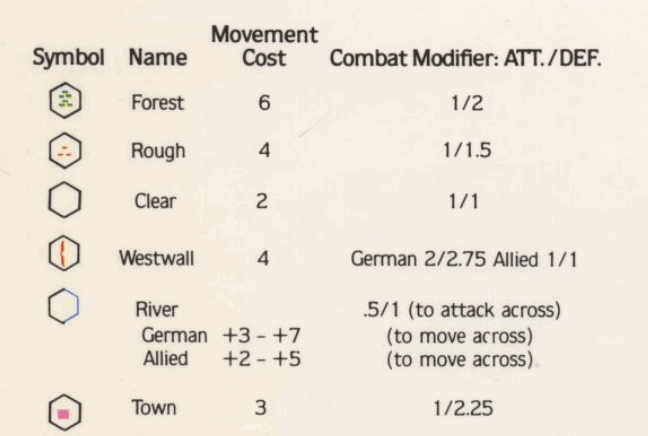
- New campaigns use the supplied terrain card: clear/plain costs 2 MP and defense ×1; forest 6/×2; rough (named ridge internally) 4/×1.5; town 3/×2.25. Their attack modifiers are ×1. Westwall costs 4 MP, with German attack ×2 and defense ×2.75, and Allied attack/defense ×1. River crossings add German +3–7 or Allied +2–5 MP and halve each formation's attack across that edge. A seeded daily cost per side and river edge makes route previews and execution agree without consuming random rolls; this stable daily assignment is an adaptation of the source's cost ranges. River defense is ×1. New player-aid units receive provisional 30 MP for armor and 24 for infantry; these allowances remain balancing adaptations. Older maps and saves retain their terrain costs and saved movement allowances.
- All readable unit names, baseline CP, dates and entry hexes from the Apple aid card are implemented. The card's airborne dates conflict with the article narrative; this mode follows the card. Dated arrivals follow the listed day's combat. The full campaign and short scenario share the same dated roster because this aid card specifies no alternate deployment or exclusion list for the short scenario.
- Older Manual saves with no reference revision retain the original terrain and reinforcement schedule: airborne days 3/5, American armor day 7, 116 Panzer day 3, 9 SS day 5. Revision 1 saves retain the later card-based dates and costs on the 15 × 12 schematic map. Neither is migrated to revision 2's map, entries or crossing rules; saved CP and movement allowances are preserved.
- Initial general supply 120 per side; daily recovery 50 German/60 American, capped at 120. Daily artillery is 6 German/4 American. German fuel starts at 120, movement consumes half terrain cost rounded up per armor hex, and armor attacks consume 2. These quantities and probability formulas are new balancing choices.
- Attack choices use Reconnaissance, Light, Medium and Major. Defense offers Counter-attack, Hold Position, Delaying Action and Withdrawal; Flexible Defense remains for legacy compatibility. Commitment factors, combat loss formulas, retreat distances, automatic artillery policy, replacement amounts, air/fuel/supply/strategy-change probabilities and weather distribution remain approximations. New Apple-supplement campaigns use its explicit second-attack probabilities and 25-CP elimination threshold, with the remaining unknown formulas documented above. Strategy commitment changes losses and resource use, not nominal odds. The original hidden combat tables are unavailable.
- New campaigns use the aid card's cumulative scoring and victory levels. Older Manual campaigns retain the eight-point objective/exits/breakthrough adaptation and early elimination victory; loading them does not convert scoring or add missing formations. Movement undo, autosaves and graphical reports are browser conveniences. AI behavior and the approved starting deployment are not claimed to reproduce the original scenario's balance.
The sections below describe Classic mode unless explicitly stated otherwise.
Your First Turn
Campaign History replaces the old Field Dispatches list. Expand it below the map to read up to 60 saved events, newest first. Labeled entries separate battles, captures, reinforcements, retreats and campaign results. Classic battle entries spell out attacker and defender losses instead of using a colon-separated pair. Keep it collapsed when following the live American and German situation panels.
Move, Attack, Undo and End Turn (or End Movement / End Combat) are in the toolbar at the top of the page, below the campaign status. The map spans the browser width, with army situation reports below it. The Order of Battle button opens a dialog with both armies' complete active rosters and combat points / remaining movement, plus each side's reinforcement schedule with arrival turn, date and current status. Arrived, delayed, eliminated and exited reinforcements retain their scheduled dates. Selecting an active formation closes the dialog and highlights it on the map. You can also select a counter directly on the map; only your commanded army can receive orders. Selected formation details, order guidance and objectives remain below the battlefield and campaign history.
American situation reports appear to the left of the map (west), German reports to the right (east). Each includes a mission statement, active formations, total strength or combat points, isolation, and held objectives. Plain-English reports explain movements, battle losses, retreat/advance, captures and arrivals. The latest sixteen reports per side are now saved across reload and import; Undo restores the reports belonging to the restored position. New Campaign starts a new history. On narrow screens the panels sit below the map in the same left/right order.
Computer vs Computer
Choose New Campaign, select either ruleset, and choose Computer vs Computer. The campaign starts paused. Next Action resolves a movement order, battle, or phase transition. The active formation is selected and a plain-English sentence explains its intent and actual battle losses. Solid side-colored arrows show movement; dashed arrows show attacks; yellow arrows and moving markers show retreat/advance. Reduced-motion settings suppress moving markers. Next Day completes the remaining orders today using exactly the same engine. Play follows individual actions at 0.5, 1.5 or 3-second intervals. You can inspect either army but cannot issue orders. Battles do not interrupt playback with dialogs. Export/import and autosaves preserve the exact order boundary; reload/import resumes paused. Rules and New Campaign also pause playback.
Seeds, AI and measured balance
Leave the replay seed blank in New Campaign for a random 32-bit seed, or enter a whole number from 0 through 4294967295. The original seed is shown in the status strip and saved separately from the changing random-generator state. Identical seeds reproduce computer campaigns with the same rules and engine version; human orders can change the random sequence and outcome. Older saves without an original seed show “seed unknown” rather than guessing.
German AI pursues valuable objectives, checks supply routes, combines adjacent forces in manual mode and conserves scarce fuel/supply. American AI intercepts approaching breakthroughs, favors defensible terrain, protects important positions and counterattacks selectively. Both avoid needless attacks with weakened formations. These are heuristics, not human-level strategic planning.
Legacy-map computer benchmarks over seeds 1–60 produced Classic: Germany 5 wins, America 55; older Manual: Germany 1, America 59. The rebuilt map's selected-roster, eight-point adaptation produced 0/60 German wins. The new full-roster, cumulative-VP player-aid campaign also produced 0/60 German wins at ratings 5/5 with the approved adapted deployment. These are not a promise of balanced human play or a 50/50 historical scenario. Regression tests preserve those benchmarks and separately test the new card rules.
The lower score area includes each army's last completed-day summary: held points, active formations and net strength change. Net change includes combat, arrivals, replacements and exits—not gross combat casualties. Individual battle reports show actual casualties. The first day of an older save may have no starting totals; the summary says so explicitly instead of inventing a change.
The campaign balance report compares Allied and German held-objective values, active formations, remaining strength (CP in Manual mode), and isolated formations. These held totals are not cumulative scores. The separate victory-rule section uses the aid card's German VP minus Allied VP and six victory levels in new Manual campaigns; Classic and older Manual campaigns retain the eight-point target. Provisional standings are not predictions. Finished campaigns show the actual victory classification.
Start a new campaign and choose to command either Germany or America; the computer controls the opposing side. Each turn represents one day, starting on 16 December 1944; the scenario ends no later than 27 December.
- Select one of your counters on the map. The yellow outline identifies your selected formation, and its Order of Battle information appears below the map. Guidance in the selected-formation panel explains legal orders and why others are unavailable.
- Choose Move. White dots mark legal destinations. Click one to move; the route is highlighted.
- Read the movement number again. If points remain, you can issue another move. Entering an enemy-adjacent hex spends the remaining allowance in Classic.
- Choose Attack. Only eligible enemies are outlined. Click one to open a risk preview—not to fire immediately. Review the strength, terrain and supply factors, then choose Resolve Attack or Cancel. Manual previews also explain readiness, artillery, general supply and commitment. Cancel consumes nothing.
- Read the resulting Battle Report for actual losses and retreats/advances. Repeat with other formations; you need not move or attack with every unit.
- Choose End Turn (or End Movement / End Combat in manual mode). The computer responds, then new orders become available.
Try movement before combat. Undo Move can reverse movement orders, but a successful attack clears the undo history. Export your campaign before experimenting with a risky battle.
Reading the Map
The centered legend above the battlefield follows your map revision. New Manual campaigns show the same forest bars, rough-terrain bars, town squares and Westwall line used on the map, plus an empty hex for clear terrain and blue hex boundaries for rivers. E marks exits and 1–28 marks entry locations. Colored hex outlines identify alternate reinforcement edges: north, west, south and German. Classic and older Manual saves retain the schematic map's text-symbol legend.
Hover over either army's map counters to see its formation name, type, current and maximum strength, movement, supply, combat status, terrain and coordinates. Manual campaigns also show readiness. Hovering does not select the unit or issue orders; move away or press Escape to dismiss the card. Keyboard and touch users can select a formation to read its details in the command panel.
G means German; A means American. = means armor and X means infantry. Numbers below the symbol show current strength / remaining movement, not attack / defense. A unit at zero strength is eliminated.
White destination dots are separate from terrain colour. Pink double outlines mark objective hexes. A town's label stays visible under an occupying unit; A3 or G3 indicates its controller and three-point value. An exclamation mark means the formation is isolated from supply.
The west is on the left; German forces start in the east, on the right. Hover over the Undo arrow for its description. With the map focused, use arrow keys to move the cursor and Enter or Space to activate a hex.
Movement & Undo
Armor normally receives five movement points each day; infantry receives four. A destination dot means a legal route fits the unit's current allowance. The engine chooses the route; you select its destination. It may capture a town along that route.
| Terrain | Symbol / colour | Movement cost | Defense multiplier |
|---|---|---|---|
| Plain | . / neutral | 1 | 1.0 |
| Road | : / amber | 1 | 1.0 |
| Forest | * / green | 2 | 1.5 |
| Ridge | ^ / amber | 3 | 1.7 |
| River | ~ / blue | 3 | 1.3 |
| Town | # / pink | 1 | 1.8 |
Units cannot stack or move through occupied hexes, even friendly ones. The six hexes around an enemy form its zone of control. Entering one ends movement; on a later turn you may leave it if a legal move exists.
Undo Move
The curved-arrow button beside Move and Attack reverses the latest movement order. Repeated clicks undo earlier moves in reverse order, including moves by different units. Position, movement points, town ownership, score and dispatches are restored.
Successful combat, End Turn, New Campaign, importing a save and page reload clear the history. Changing selection or mode does not clear it; an invalid order does not consume an undo. History is not included in exported saves.
Combat
The preview explains nominal odds before you commit. In Classic it gives the exact range of initial losses from the combat roll, separately warning about blocked-retreat losses. In manual mode it is not an exact casualty forecast: random supply failures, altered orders, air effects and low-strength elimination can change the outcome. A favorable ratio is never a guaranteed result.
Only adjacent opposing units can fight. Each formation can attack once per day. An attack consumes all its remaining movement, even when the outcome is unfavorable. No ranged attacks or combined multi-unit attacks are modeled.
Effective attack is the attack rating multiplied by the unit's fraction of remaining strength and its supply modifier. Effective defense uses the same strength fraction, the defense rating, the hex's terrain multiplier and supply. The ratio is shown in dispatches: 2.0:1 means twice as much effective attack as defense, not a guaranteed win.
Armor has attack 8 and defense 6; infantry has attack 5 and defense 5. For example, full-strength supplied armor attacking full-strength supplied infantry in a town has odds of about 8 / (5 x 1.8) = 0.9:1. Towns can make an apparently strong attack costly.
A seeded random roll determines strength losses and possible retreat. Dispatch losses are listed as attacker:defender. Retreats choose an empty neighboring hex outside enemy zones of control, favoring the defender's friendly edge. A blocked retreat causes two extra strength losses. The attacker does not automatically advance into the vacated hex.
Protect depleted formations. Low strength reduces combat effectiveness. Favorable odds help, but are not a promise of victory. The seed is saved with the campaign; there is no combat undo.
Supply
At the start of each side's orders, units trace supply to their friendly map edge: east for Germany and west for America. Routes cannot pass through enemy counters or empty hexes in an enemy zone of control. Friendly occupied hexes can carry supply, including in those zones.
An isolated formation loses two movement points, attacks at half effectiveness and defends at three-quarters effectiveness. From day two it loses one strength when its side starts, but supply attrition never reduces it below one. Movement allowance also has a minimum of one.
The displayed supply status is the assessment at the start of that side's orders; it does not recalculate after every move. A route cut during movement therefore affects the next supply assessment.
Weather & Reinforcements
| Day / date | Weather or arrival |
|---|---|
| 1-3 / 16-18 December | Fog. 101 Airborne arrives on day 3. |
| 4-7 / 19-22 December | Fog or snow, determined each day. 82 Airborne arrives on day 5; 4 Armored and 3 Armored on day 7. |
| 8-12 / 23-27 December | Clear weather. |
Snow reduces every unit's daily movement allowance by one. Armor also pays one extra movement point per entered hex unless it is a road or town. Fog has no additional movement or combat penalty and does not hide units. Clear weather adds one to American combat damage as a simplified representation of Allied air support.
Reinforcements enter at designated positions, or nearby available western hexes if those positions are occupied. Their counters appear immediately on the map with a highlighted border and NEW marker throughout their arrival turn, including after saving and reloading. The reinforcement list below the map shows each arrival's current column and row; click an entry to locate it on the map and select it if it belongs to your side. Markers disappear on the next turn, but surviving units remain on the battlefield. They are part of this scenario's simplified balance, not a precise order of battle.
Winning & Strategy
Hold at least eight objective points after the American response on turn twelve to win as Germany. Reaching eight earlier does not immediately end the game. Eliminating every enemy formation gives an early victory; losing every German formation is a defeat regardless of your objective score.
| Objective | Points |
|---|---|
| Dinant | 4 |
| Meuse | 4 |
| Bastogne | 3 |
| St. Vith | 2 |
| Malmedy | 2 |
Entering or passing through an objective transfers control. Control persists after departure until the other side enters. The score is held territory, not a cumulative reward for captures.
- Choose a route toward objectives, not just the nearest enemy.
- Keep your supply route open and avoid isolating spearheads.
- Use roads when practical, especially during snow.
- Do not spend depleted units on repeated low-odds attacks into towns.
- Leave enough strength to defend captured objectives against American responses.
These are strategic suggestions, not a proven winning script. See the current multi-seed AI measurements above; scenario balance still needs human playtesting.
Saving Your Campaign
The game autosaves after successful orders and Undo in this browser's local storage. Reloading restores the last saved state, but not undo history. New Campaign replaces the autosave after confirmation.
Export Save downloads a JSON campaign file. Import Save loads one after validation and replaces your current campaign. Export first before importing a different game. If browser storage is unavailable, use exports to preserve progress.
Saves are browser-local, not cloud accounts. They do not automatically sync between devices, browsers, the local file version and GitHub Pages. Export on the old location and import on the new one. Clearing browser site data can erase the autosave.
Common Questions
Why are there no destination dots?
Select a living German unit and choose Move. It may have spent its allowance, have no affordable empty destinations, or have already attacked. No orders are available during the American response or after victory.
Why did my move use every movement point?
Entering a hex adjacent to an enemy ends movement. Terrain and snow may also spend the full allowance. Use Undo Move before combat or ending the turn to reverse a mistaken order.
Why can I not attack that unit?
The target must be an opposing unit exactly one hex away. Choose Attack; ensure your selected unit is alive and has not attacked this turn. Clicking a friendly counter selects it instead.
Why is Undo disabled?
No successful move is available to undo, or combat, turn completion, restart, import or reload cleared the history. Undo never reverses a battle or an American response.
Why did I lose with eight points?
All German formations may have been eliminated. Eight points wins only if German forces survive and hold that score after the final American response. Objective capture by the AI can also lower your score.
Is this the original Tigers in the Snow?
No. It is an independent browser game inspired by early hex-based computer wargames. Its map, combat rules, scenario balance and coloured interface are original approximations, not a verified recreation of the TRS-80 version.
Historical Background
The Battle of the Bulge was a major German offensive on the Western Front, beginning on 16 December 1944 in the Ardennes. German forces sought to break through the Allied front, cross the Meuse and divide the Allied armies, with Antwerp as the broader strategic goal. Their advance formed the bulge in Allied lines that gave the battle its common name. U.S. Army historical overview.
Wooded terrain, winter weather, limited roads and fuel constraints shaped the fighting. American resistance at crossroads including St. Vith and Bastogne delayed the offensive while Allied reinforcements moved into the region. British forces also helped secure the Meuse approaches. The outcome depended on far more than the simplified five-objective map in this game.
A Short Timeline
- 16 December 1944: German forces launch the Ardennes offensive against the American-held front.
- Following days: German spearheads push west; resistance at St. Vith and Bastogne disrupts their timetable. Allied commanders commit reinforcements.
- Late December: Improving weather allows increased Allied air operations; German advances stall short of the Meuse.
- 26 December: Elements of the U.S. 4th Armored Division establish contact with the surrounded defenders of Bastogne.
- January 1945: Allied counterattacks reduce the salient. The U.S. Army dates the battle's conclusion to 25 January.
The battle ended in an Allied victory, at great cost to soldiers and civilians. Playing Germany here is a strategic role within a historical game, not an endorsement of Nazi Germany or its ideology.
History Versus This Scenario
The game ends on 27 December, before the historical battle ended. Its hex map is schematic, not geographically accurate. Meuse is a river objective, not a town. Unit strength points are abstract, not troop or tank counts. Reinforcement dates, supply losses, weather changes and combat odds are gameplay rules rather than historical measurements.
TRS-80 Inspiration
Tigers in the Snow was published by Strategic Simulations in 1981 and designed by Chuck Kroegel, David Landrey and David Walker. It appeared on platforms including the TRS-80, Apple II and Atari 8-bit computers, with later ports. Its board-wargame-inspired hex grid included terrain, weather and supply systems. Game background and references.
Ardennes: Winter Offensive borrows the idea of a compact, counter-based operational wargame. It uses new browser code, a simplified scenario and modern conveniences such as colour, autosaves and movement undo. It is not affiliated with SSI, and this guide describes only the browser game's current rules.
Sources & Further Reading
Historical prose in this guide is a summary, not reproduced source text. Consult these references for broader context and differences between the real battle and the game.
- U.S. Army: Battle of the Bulge — overview, photographs and further reading.
- Hugh M. Cole: The Ardennes: Battle of the Bulge — U.S. Army official campaign history.
- The National WWII Museum: Battle of the Bulge — historical overview.
- Tigers in the Snow — original game's publication details and bibliography.
Guide updated 10 October 2026. Game rules are based on the current implementation; external sources cover history, not these mechanics. Source links require an internet connection; the guide itself works offline.